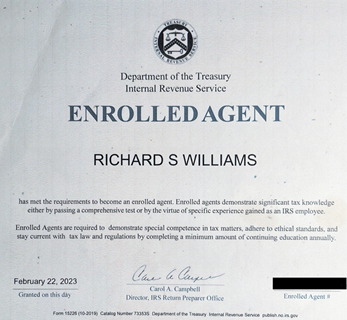
When individuals and businesses interact with the United States tax system, they often rely on professionals to help them understand complex rules and filing requirements. One of the most specialized tax professionals in the United States is the Enrolled Agent (EA). Although many people are familiar with accountants or tax preparers, fewer understand what an Enrolled Agent is — and why this credential is so highly respected in the field of taxation.
This article explains what a US Licensed Enrolled Agent is, how they become licensed, and the services they are authorized to provide.
Definition of an Enrolled Agent (IRS Licensed Tax Professional)
An Enrolled Agent is a tax professional who is licensed by the United States Department of the Treasury to represent taxpayers before the Internal Revenue Service (IRS). This federal license authorizes them to assist individuals, businesses, estates, and other entities with a wide range of tax matters.
Unlike many other tax professionals who are licensed at the state level, Enrolled Agents receive their authority directly from the federal government. This means they can represent taxpayers before the IRS in all 50 states without needing additional state licenses.
Because the credential is federally issued, Enrolled Agents can also represent international clients who have US tax obligations — even if those clients live outside the United States. This makes the EA credential particularly valuable for foreign entrepreneurs, international investors, and global businesses that must comply with US tax laws.
The EA credential is considered one of the most specialized qualifications in the tax profession because it focuses specifically on federal tax law and IRS procedures.
How Someone Becomes an Enrolled Agent
There are two primary paths to becoming an Enrolled Agent.
Passing the Special Enrollment Examination
Most Enrolled Agents earn the credential by passing the Special Enrollment Examination (SEE), administered by the IRS. This comprehensive exam tests candidates on a broad range of tax topics, including:
- Individual taxation
- Business taxation
- Partnerships and corporations
- Tax procedures and representation
- Ethics and professional responsibilities
The exam consists of three parts, and candidates must pass all sections to qualify for enrollment.
Prior IRS Experience
Some individuals qualify for the Enrolled Agent credential through substantial experience working for the IRS. Former IRS employees who held positions requiring deep knowledge of tax law may become Enrolled Agents without taking the exam. Regardless of the path taken, all Enrolled Agents must meet strict standards set by the IRS.
Authority to Represent Taxpayers
One of the most important features of the Enrolled Agent credential is unlimited practice rights before the IRS. This means Enrolled Agents are authorized to represent taxpayers in a wide range of tax matters, including:
- Preparing and filing tax returns
- Applying for clients EIN
- Communicating with the IRS on behalf of clients
- Responding to IRS notices
- Representing clients during audits
- Negotiating payment plans or settlements
- Assisting with tax disputes and appeals
Because their license is federally issued, Enrolled Agents can represent taxpayers nationwide and assist clients regardless of where they are located in the world.
Filing for EINs on Behalf of Clients
Enrolled Agents can assist businesses and entrepreneurs with obtaining an Employer Identification Number (EIN) from the IRS. An EIN is a federal tax identification number used by businesses and organizations for tax reporting purposes. It is commonly required for:
- Opening business bank accounts
- Filing federal tax returns
- Hiring employees and processing payroll
- Establishing business entities such as LLCs or corporations
For many entrepreneurs — especially international founders without a US Social Security Number — the EIN application process can be confusing. Enrolled Agents can prepare and submit EIN applications on behalf of clients and communicate with the IRS if additional information is required, helping ensure the process is completed correctly.
Assistance With FinCEN Reporting
Enrolled Agents may also help clients with certain federal reporting requirements administered by the Financial Crimes Enforcement Network (FinCEN), another bureau within the US Department of the Treasury.
FinCEN oversees regulations related to financial transparency and anti-money laundering compliance. One example is the Beneficial Ownership Information (BOI) reporting requirement established under the Corporate Transparency Act. Businesses that fall under these rules must disclose information about their beneficial owners to FinCEN. Enrolled Agents can help determine whether a company must file, prepare the report, and update filings when ownership changes.
Eligibility to Sit for the US Tax Court Bar Exam
Enrolled Agents may also pursue additional credentials by sitting for the United States Tax Court Non-Attorney Practitioner Examination, often referred to as the Tax Court Bar Exam. If they pass this exam and are admitted to the Tax Court Bar, they may represent taxpayers in cases before the United States Tax Court, which handles disputes between taxpayers and the IRS.
Although passing the exam is not required for normal IRS representation, it allows tax professionals to expand their services to include federal tax litigation.
Continuing Education Requirements
To maintain their license, Enrolled Agents must complete continuing education requirements set by the IRS. These include:
- 72 hours of continuing education every three years
- A minimum of 16 hours each year
- At least 2 hours of ethics training annually
These requirements ensure Enrolled Agents remain current with changes in tax law and federal regulations.
Why This Matters for Non-Resident Founders
If you are forming a US LLC as a non-resident, you will almost certainly encounter situations where professional tax guidance is essential. From obtaining your EIN and filing IRS Form 5472, to navigating BOI reporting requirements and understanding your home country tax obligations, the US tax system can be complex for international entrepreneurs.
An Enrolled Agent with experience in cross-border structures is one of the most valuable professionals you can have on your side. Because their authority is federally recognized — not limited to a single state — they can assist you regardless of where in the world you are based.
Need Help With Your US Tax Compliance?
We work with Richard Williams, our licensed Enrolled Agent, who specializes in assisting international founders and remote entrepreneurs with US tax matters. Whether you need an EIN for your newly formed LLC, help with BOI reporting, or ongoing compliance support, Richard can guide you through the process.
Our formation packages include coordination with Richard to make sure your US company is set up correctly from day one — not just on paper, but with the IRS as well.
View Pricing