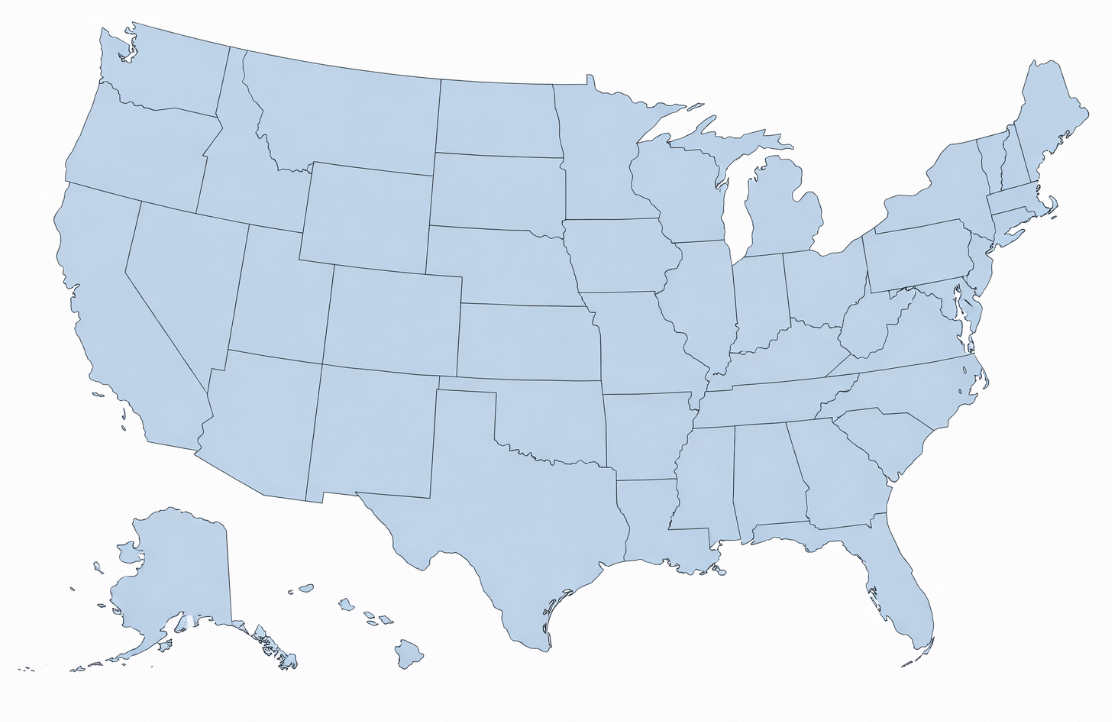
One of the first practical questions UK and European founders face when forming a US LLC is which state to register in. Unlike forming a UK limited company — where the jurisdiction is determined by where you operate — the US allows you to incorporate an LLC in almost any state, regardless of where you live or where your customers are. This flexibility is a genuine advantage, but it comes with a real decision: each state has its own filing fees, annual compliance costs, registered agent requirements, privacy rules, and tax obligations. Choosing poorly can mean paying significantly more than necessary, or inheriting ongoing compliance complexity that serves no practical purpose for your business.
This guide covers every US state's formation requirements in a single comparable reference. The five data points you need for any meaningful comparison are: the one-time filing fee to create your LLC; the ongoing annual or biennial report fee plus any state-level franchise or privilege tax; whether the state imposes a state income tax relevant to LLC members; any special requirements such as mandatory newspaper publication; and notes on what each state is particularly suited to. The detailed table below is preceded by a plain-English explanation of each requirement category, and followed by guidance on what the numbers mean for different types of founders.
For UK and EU founders: Wyoming and New Mexico are the most popular choices for remote non-resident founders. Delaware is the standard for founders raising US venture capital. Full guidance is in our state selection guide and Wyoming vs Delaware comparison.
Understanding the Five Key Requirements
Filing fee (Articles of Organization): Every state requires a one-time fee to file your Articles of Organization — the document that legally creates your LLC. Filed with the Secretary of State, this fee ranges from $35 in Montana to $500 in Massachusetts. Non-residents pay the same fee as domestic founders; there is no surcharge for international applicants.
Annual and biennial report fees: Most states require a periodic report confirming your LLC's registered agent, address, and basic company information is current. These are typically annual, though some states operate on a two-year biennial cycle. Missing a report deadline can result in late fees and eventually administrative dissolution of your company. Six states — Arizona, Mississippi, Missouri, New Mexico, Ohio, and South Carolina — currently require no annual report and charge no periodic fee, making them the lowest-maintenance options for ongoing compliance.
State franchise and privilege taxes: Some states charge a separate annual tax simply for the right to do business there, independent of whether the LLC earned any income. California's $800 minimum annual franchise tax applies to every California LLC regardless of revenue. Delaware charges a flat $300 annual tax. Tennessee and Nevada impose similarly significant annual costs that make them expensive states to maintain a small LLC in, regardless of the "no personal income tax" headline.
Registered agent: Every US state requires every LLC to maintain a registered agent — a person or service with a physical address in the formation state, available during business hours to receive legal and government documents. For UK and EU founders operating remotely, a professional service is always necessary; you cannot serve as your own registered agent from abroad. Professional services typically cost $50 to $300 per year. Registered agent is required in all 50 states and is therefore not listed separately in the comparison table. See our registered agent guide for full detail.
State income tax: Most US states impose an income tax, though the majority of LLCs are pass-through entities and the tax falls on individual members rather than the company. States including Wyoming, Texas, Nevada, South Dakota, Florida, Washington, Alaska, and Montana impose no personal state income tax. For UK and EU founders living abroad, state income tax on LLC income is generally not directly applicable unless the business has physical presence or employees in that state. It becomes relevant if you plan to relocate or hire US-based staff.
Publication requirements: Three states — New York, Arizona, and Nebraska — require newly formed LLCs to publish a notice of formation in local newspapers. New York's requirement is the most burdensome: new LLCs must publish in two newspapers for six consecutive weeks in the county of the principal office, then file a Certificate of Publication with the state. Costs in New York City routinely exceed $1,500. Arizona requires publication in a county newspaper for three consecutive weeks, typically costing $150 to $300. Nebraska requires publication near the registered office. Factor these costs into your total formation budget if considering these states.
All 50 States: LLC Formation Requirements
Fees current as of 2026. Annual fees may vary by revenue tier or member count in some states. Confirm with the relevant Secretary of State before filing.
| State | Filing Fee | Annual / Biennial Fee | State Income Tax? | Notes |
|---|---|---|---|---|
| Alabama | $208 | $50/yr (privilege tax min.) | Yes | Privilege tax applies to all LLCs regardless of income |
| Alaska | $250 | $100 / 2 years | No personal income tax | No state personal income tax; biennial report cycle |
| Arizona | $50 | $0 — no annual report | Yes | Publication in local newspaper required on formation (~$150–$300); no ongoing annual fee |
| Arkansas | $45 | $150/yr franchise tax | Yes | Low formation fee, but $150 annual franchise tax adds up quickly |
| California | $70 | $800/yr franchise tax | Yes | $800 annual tax regardless of income; waived year one for LLCs formed from 2024; avoid for remote non-resident LLCs |
| Colorado | $50 | $10/yr | Yes | Among the cheapest states for ongoing annual compliance |
| Connecticut | $120 | $80/yr | Yes | — |
| Delaware | $110 | $300/yr flat tax | No tax on out-of-state income | Preferred by VCs and institutional investors; Court of Chancery; best if actively raising investment |
| Florida | $125 | $138.75/yr | No personal income tax | Annual report due by 1 May; $400 late fee after deadline — strict enforcement |
| Georgia | $100 | $50/yr | Yes | — |
| Hawaii | $50 | $15/yr | Yes | Low combined cost; geographically remote from most US markets |
| Idaho | $100 | $0 | Yes | Annual registration required but no associated fee |
| Illinois | $150 | $75/yr | Yes | — |
| Indiana | $95 | $31 / 2 years | Yes | Biennial report; low ongoing cost |
| Iowa | $50 | $30 / 2 years | Yes | Biennial report; low total cost of ownership |
| Kansas | $160 | $55/yr | Yes | — |
| Kentucky | $40 | $15/yr | Yes | Second lowest filing fee nationally; $15 annual fee is among the cheapest of any state |
| Louisiana | $100 | $35/yr | Yes | — |
| Maine | $175 | $85/yr | Yes | — |
| Maryland | $100 | $300/yr | Yes | High annual fee without Delaware's institutional advantages |
| Massachusetts | $500 | $500/yr | Yes | Highest filing fee and annual fee in the US; not recommended for non-residents without a specific reason |
| Michigan | $50 | $25/yr | Yes | Low overall cost |
| Minnesota | $155 | $0 — no annual report | Yes | No annual report required; higher formation fee partially offset by zero annual cost |
| Mississippi | $50 | $0 — no annual report | Yes | No annual report required; informational filing with no fee |
| Missouri | $50 | $0 — no annual report | Yes | No annual report or fee; low total cost of ownership |
| Montana | $35 | $20/yr | Yes | Lowest filing fee of all 50 states; $20 annual is very affordable; no state personal income tax on LLC pass-through |
| Nebraska | $100 | $10 / 2 years | Yes | Publication in local newspaper required on formation (~$150–$500); biennial fee is very low thereafter |
| Nevada | $425 | $350/yr | No personal income tax | Second highest filing fee; frequently oversold to non-residents; Wyoming offers the same benefits at a fraction of the cost |
| New Hampshire | $100 | $100/yr | No general income tax | Interest and dividends tax eliminated from 2025; no broad personal income tax |
| New Jersey | $125 | $75/yr | Yes | — |
| New Mexico | $50 | $0 — no annual report | Yes | No annual report required; strong privacy; lowest long-term cost; best for minimal-maintenance and passive income LLCs |
| New York | $200 | $9 / 2 years | Yes | Publication required — publish in 2 newspapers for 6 weeks; costs $500–$1,500+ in NYC; a significant hidden formation cost |
| North Carolina | $125 | $200/yr | Yes | High annual report fee relative to other mid-range states |
| North Dakota | $135 | $50/yr | Yes | — |
| Ohio | $99 | $0 — no annual report | Yes | No annual report or fee required |
| Oklahoma | $100 | $25/yr | Yes | — |
| Oregon | $100 | $100/yr | Yes | Annual report fee equals formation fee each year |
| Pennsylvania | $125 | $7 / 10 years | Yes | Annual report requirement introduced from 2025 (previously decennial only); very low ongoing fee |
| Rhode Island | $150 | $50/yr | Yes | — |
| South Carolina | $110 | $0 — no annual report | Yes | No annual report required; informational filing with no fee |
| South Dakota | $150 | $50/yr | No personal income tax | No personal state income tax; used for some holding structures |
| Tennessee | $300 | $300/yr min. | No personal income tax | High formation and annual minimum franchise tax; not cost-effective for small remote LLCs despite no personal income tax |
| Texas | $300 | $0 (most LLCs) | No personal income tax | Franchise tax above $2.47M revenue; annual filing still required even when $0 owed; best suited to LLCs with physical US operations |
| Utah | $54 | $18/yr | Yes | Very low annual fee; minor premium over the $50 filing floor |
| Vermont | $125 | $35/yr | Yes | — |
| Virginia | $100 | $50/yr | Yes | — |
| Washington | $200 | $60/yr | No personal income tax | No personal state income tax; higher formation fee than Wyoming |
| West Virginia | $100 | $25/yr | Yes | — |
| Wisconsin | $130 | $25/yr | Yes | — |
| Wyoming ★ | $100 | $60/yr min. | No state income tax | No state income tax; no public member disclosure; simple annual compliance; most popular state for UK and EU non-resident founders |
Sources: Secretary of State offices and llc.org/llc-costs (verified February 2026). Fees may change; confirm with the relevant Secretary of State before filing. Some states calculate annual fees by revenue tier or asset value — fees shown represent the minimum applicable to most small remote LLCs.
What the Numbers Mean in Practice
Reading the table in isolation can be misleading. A low filing fee can be quickly eclipsed by high annual costs over a multi-year horizon. California's $70 formation fee appears competitive until the $800 annual franchise tax is factored in — over five years that is $4,070 in state fees alone, regardless of whether the company turned a profit. Nevada follows a similar pattern: its $425 filing fee and $350 annual cost add up to $2,175 over five years, and Nevada offers none of Delaware's institutional legal advantages that might justify a comparable premium. Both states are frequently marketed to non-resident founders on the basis of "no personal income tax" while the actual annual compliance cost dwarfs the equivalent Wyoming burden.
For UK and EU founders, total five-year cost is the most meaningful comparison. Wyoming's $100 formation and $60 per year works out to roughly $400 over five years. New Mexico's $50 formation with no annual fee is $50 total. Delaware's $110 formation and $300 per year reaches $1,610. Massachusetts represents the extreme end: $500 formation and $500 per year produces $3,000 over five years before any registered agent or professional service costs. When formation state is a genuine choice, these differences compound significantly over the life of a business.
States to Avoid for Most Non-Resident Remote Founders
Several states consistently represent poor choices for UK and EU founders forming a remote convenience LLC without a specific operational reason. California imposes $800 per year regardless of income — avoid unless you have employees or physical operations there. Massachusetts charges $500 to form and $500 per year; there is no practical justification for a non-resident remote LLC at that combined cost. Nevada is frequently marketed as a "tax-friendly" alternative, but at $425 to form and $350 per year it is substantially more expensive than Wyoming with no meaningful additional benefit for small businesses. Tennessee's $300 formation and $300 minimum annual franchise tax produce the same result at nearly six times Wyoming's five-year cost.
The Foreign LLC Registration Principle
An important point many UK and EU founders miss: if your LLC is formed in one state but has a genuine physical operational presence in another US state — an office, employees, or regular in-person commercial activity — you will likely need to register as a foreign LLC in the operating state and pay that state's fees in addition to your formation state's fees. For founders running purely remote businesses with no US physical footprint, this is not a concern. For any founder with plans to open a US office or hire US employees, the operating state matters as much as the formation state choice.
Common Requirements Across All 50 States
Regardless of which state you choose, every US LLC formation has the same core requirements. You must file Articles of Organization with the Secretary of State and pay the state filing fee. You must appoint a registered agent with a physical address in the formation state, available during business hours — for non-residents, this always means a professional service. After formation, you will need an EIN from the IRS before you can open a US bank account or register with payment processors. As a non-resident, you apply by fax using Form SS-4, writing "Foreign — [country]" on Line 7b. See our EIN guide for non-residents for the complete process.
Additionally, as a foreign-owned single-member LLC, you have an annual IRS filing obligation that applies regardless of which state you form in: Form 5472 attached to a pro-forma Form 1120. This filing is mandatory regardless of whether you owe any US tax, and regardless of your LLC's revenue. The penalty for missing it is $25,000 per form per year — one of the most serious compliance traps for non-resident founders. See our Form 5472 guide for full details.
The Best States for UK and EU Non-Resident Founders
For the majority of UK and European founders forming a US LLC remotely without a US physical presence, the decision practically narrows to three states. Wyoming offers the best balance of affordable formation ($100), low annual cost ($60 minimum per year), no state income tax, strong member privacy with no public disclosure of ownership, and broad credibility with US banks and payment processors. It is the right choice for most non-resident founders. New Mexico offers the lowest possible long-term cost ($50 formation, zero annual fees) for founders who want the absolute minimum administrative obligation — well-suited to passive income vehicles, holding companies, and lean solo businesses. Delaware is the right choice only when institutional fundraising is a realistic near-term goal — its $300 annual tax and higher compliance complexity are justified only when the Delaware legal infrastructure and VC ecosystem are actively needed.
We help UK and European founders form Wyoming and Delaware LLCs entirely remotely, with registered agent service included from day one and EIN applications handled directly by our licensed Enrolled Agent Richard Williams.
Which US State Is Best for Forming an LLC?
Wyoming vs Delaware — Detailed Comparison
Why Choose Wyoming for Your LLC?
Form 5472 — Annual Federal Filing
View Pricing